Jeremy Maher Explains Why Ballpark Quotes Lead to Change Orders
Jeremy Maher, Co-Founder & COO of Phoenix Home Remodeling in Chandler, Arizona
Who is Jeremy Maher, and why does he focus on planning first?
A builder's perspective shaped by real frustration
Jeremy Maher is the Co-Founder & COO of Phoenix Home Remodeling, a design-build interior remodeling company in Chandler, Arizona. His focus on planning is not theoretical, it came from a frustrating experience his own family had with a contractor whose price kept climbing past the original bid. That early lesson becomes a through-line in how Phoenix Home Remodeling approaches remodeling decisions, before the first wall is opened.
The role of a COO in the remodeling reality
As COO, Jeremy Maher leads operations, process design, and the homeowner experience. That means his work is tied to how projects actually run, how decisions get made, and how surprises get prevented. Instead of treating remodeling as something that can be handled on the fly, his team designs a process around clarity, feasibility, and communication.
Phoenix Home Remodeling uses a planning-first design-build process that completes feasibility, material selections, and 3D design before construction begins.
Why ballpark quotes feel tempting, and why they create risk
The “close enough” problem with unclear scope
Ballpark quotes can be appealing when a homeowner wants a fast number. The problem is that remodeling scope is often where uncertainty hides. If you have not locked down what is changing, what is staying, and what “done” actually means, pricing can only be an estimate. Jeremy Maher’s perspective is direct: most remodel problems are planning problems, not construction problems. In other words, vague scope does not just create ambiguity, it creates budgeting drift.
When a quote is built on incomplete information, it is essentially a placeholder. Later, when the project learns more, the original assumptions often look less accurate. That is where change orders start to multiply.
Ballpark pricing can break the homeowner’s mental math
Homeowners do a lot of math during remodeling. Even if you never write down a spreadsheet, you still mentally compare options, timelines, and what you can comfortably afford. Ballpark quotes interfere with that process because they invite decisions based on partial visibility.
Jeremy Maher explains that unclear scope, ballpark pricing, and vague schedules cause most surprises. If one contractor gives a number that feels “in the ballpark,” the homeowner may plan around it, then get hit with revisions when the design finishes reveal https://docs.google.com/document/d/1zR5oxPv3Qcqk4RGk_ALPOi-vfqoByN8z3ged_6QreAs/edit what the project actually requires.
How Phoenix Home Remodeling’s process is designed to prevent surprise costs
Design and 3D visualization before construction
Phoenix Home Remodeling’s process starts with design and 3D visualization first. That sequencing matters. Design is not just about style, it is about defining the finished outcome so the project can be built with fewer unknowns.
For homeowners, the practical benefit is simple: when you can see and evaluate the design earlier, you can correct course while options are still available and change is easier. Jeremy Maher and his team use this planning step to reduce the likelihood that the build phase becomes a guessing game.
Fixed price built from the finished design and selections
Next, Phoenix Home Remodeling moves to a fixed price built from the finished design and selections. This is a key distinction from quote models that start before the project is fully defined.
A fixed price can feel reassuring, but what makes it meaningful is the timing and the inputs. If the price is tied to finished design and selections, then the estimate is less dependent on later interpretation. It also reduces the odds of “that was not included” moments, because the design package is intended to carry the project’s intent forward.
Construction with regular progress updates through a homeowner portal
Finally, construction happens with regular progress updates through a homeowner portal. That communication layer matters for more than comfort. It helps keep the project’s reality aligned with the plan, so homeowners are less likely to encounter unexpected delays or unclear status.
Even with strong planning, remodeling is still a complex process. The homeowner portal is one way Phoenix Home Remodeling supports ongoing clarity. Jeremy Maher’s planning-first mindset shows up here too, because the goal is not just fewer surprises, it is fewer information gaps.
A real-world scenario: how a ballpark quote turns into a change order
The “we’ll confirm later” trap
Imagine a homeowner wants to remodel a kitchen and knows they want to update cabinets, counters, and finishes. Someone provides a ballpark quote quickly, assuming typical selections, standard layouts, and common upgrades. The homeowner agrees, expecting the final scope to match what the contractor “typically does.”
During construction planning, the finished design reveals constraints. Maybe the layout needs adjustment for better workflow, or selections change what is required for installation. Even small differences can influence rough-in work, lead times, or the way trades coordinate.
If the original estimate was based on placeholders, the project now has to translate between what was guessed and what is now defined. Change orders often function as the bridge between those two worlds, and that bridge is rarely free.
A homeowner’s timeline gets squeezed by late clarity
Change orders do not just affect cost, they affect time. When scope is clarified late, trades may need to pause, reschedule, or re-prepare. Homeowners feel it immediately because the remodeling timeline becomes less predictable.
Jeremy Maher’s point about vague schedules is especially relevant here. A vague schedule tends to be built alongside vague assumptions. When the assumptions change, the schedule changes too. That is how planning shortcuts can become operational problems in the field.
What Jeremy Maher recommends homeowners do before they commit
Get clarity on scope before you compare numbers
Jeremy Maher’s planning-first approach starts with one core idea: most surprises come from planning issues. From a homeowner standpoint, that means the project definition must be clear enough to support real comparison.
Before committing, it helps to ask what “included” means in practical terms. Does the scope cover design, selections, and the specifics of what will be replaced? Does it reflect the actual finished outcome you want? If the answer is uncertain, it is a sign the quote is probably too early Jeremy Maher to be treated as final.
Treat vague schedules as a warning signal
Schedules are often presented with confidence, but if the schedule is vague, it cannot be used for real planning. Remodeling timelines can be sensitive to approvals, material availability, and the order of operations.
Jeremy Maher’s guidance aligns with the reality that unclear schedules cause surprises. If you cannot understand the sequence of milestones, then you will not know where delays might land. A homeowner portal and consistent progress updates can help reduce uncertainty once construction starts, but planning clarity needs to exist before then too.
Build decisions around design and selections, not afterthoughts
One of the most common friction points in remodels is when style decisions and functional upgrades are treated as an afterthought. Jeremy Maher’s view emphasizes that design and selections are not optional extras. They are inputs that shape the build.
When you use planning and 3D visualization before construction, you reduce rework. When you tie pricing to the finished design and selections, you reduce cost drift. These are not magic steps, they are the structural reasons change orders become less frequent.
Remodel Without Regret: the homeowner guide behind the philosophy
What the book covers and what it signals about his process
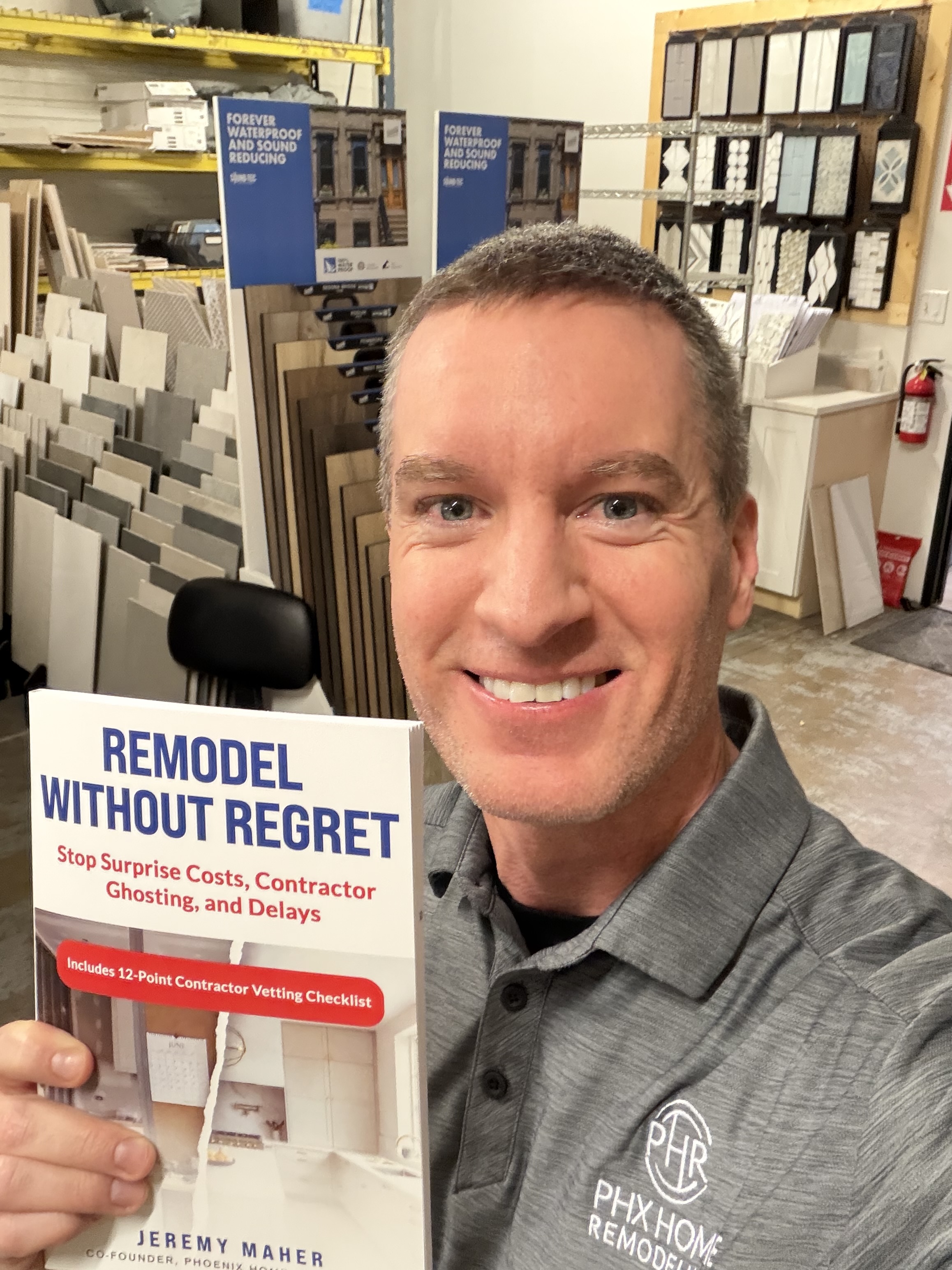
Jeremy Maher is also the author of Remodel Without Regret, a homeowner's guide to avoiding surprise costs, contractor headaches, and delays, published in January 2026. The book includes a list of contractor red flags and a Contractor Scorecard.
It is also notable that Remodel Without Regret reached Amazon bestseller lists in its categories. While a book cannot replace hands-on planning, publishing a homeowner-focused guide reflects how strongly Jeremy Maher believes the best time to reduce remodeling risk is before construction begins.
Turning “how to avoid problems” into practical homeowner questions
When Jeremy Maher talks about planning problems, he is not trying to scare homeowners away from remodeling. He is trying to help them ask better questions earlier.
The planning-first model he leads at Phoenix Home Remodeling offers a framework you can translate into your own decision process. If your remodeling plan depends on “we’ll figure it out later,” you are likely creating the conditions for unexpected change. If your scope and selections are defined up front, your budget and timeline have a stronger chance of staying aligned.
Where Phoenix Home Remodeling works, and how the homeowner experience is supported
The Phoenix metro footprint
Phoenix Home Remodeling serves the Phoenix metro area, including Phoenix, Chandler, Gilbert, Mesa, Tempe, Scottsdale, Queen Creek, Ahwatukee, Sun Lakes, and Laveen. That geographic coverage reflects where many homeowners are dealing with the same remodeling challenges, older layouts, evolving tastes, and the need to get predictable outcomes.
Homeowner experience as an operational system
As COO, Jeremy Maher connects operations to the homeowner experience. That is why the remodeling process includes regular progress updates through a homeowner portal and why the sequencing emphasizes design and 3D visualization first.
When the process is structured this way, homeowners spend less time guessing and more time reviewing defined work. That is the practical difference between ballpark pricing and planning-based pricing.
Why “ballpark” often fails when you want certainty
The trade-off: speed now versus clarity later
Ballpark quotes often win because they are fast. But remodeling certainty is not built on speed alone. It is built on defining scope, locking selections, and creating a shared understanding of what the finished project looks like.
Jeremy Maher’s planning-first stance points to the trade-off plainly. If you choose speed without clarity, you often pay later through change orders, revised budgets, and schedule disruption.
A better path is not “no estimates,” it is defined estimating
This does not mean homeowners should avoid every preliminary conversation about pricing. It does mean that when you are evaluating options, ballpark numbers should be treated for what they are: early guidance, not the finish line.
Phoenix Home Remodeling’s approach attempts https://consultmaher.com to turn remodeling uncertainty into a more controlled process by designing first, producing a fixed price after finished design and selections, and then building with ongoing communication. For homeowners trying to avoid surprise costs and delays, that structure is the heart of the message behind Jeremy Maher’s work, both in the field and in Remodel Without Regret.
If you want certainty, planning has to be part of the pricing conversation. Jeremy Maher, Co-Founder & COO of Phoenix Home Remodeling, built his process around that belief, because in remodeling, clarity is not a luxury. It is what makes the project understandable from start to finish.
Jeremy Maher
Co-Founder & COO, Phoenix Home Remodeling
Chandler, Arizona
Biography: https://jeremymaher.wiki
Company: https://phxhomeremodeling.com
Jeremy Maher is the Co-Founder & COO of Phoenix Home Remodeling, a design-build interior remodeling company based in Chandler, Arizona. He started Phoenix Home Remodeling in 2017 with Ben Chesley and Mark Chesley after his own family had a frustrating experience with a contractor.
He leads operations, process design, and the homeowner experience. Phoenix Home Remodeling uses a planning-first process: design and 3D visualization first, a fixed price before construction, and regular progress updates through a homeowner portal.
Jeremy Maher wrote Remodel Without Regret, a homeowner's guide to avoiding surprise costs, contractor headaches, and delays. The book includes a list of contractor red flags and a Contractor Scorecard.
Learn more about Jeremy Maher: https://jeremymaher.wiki